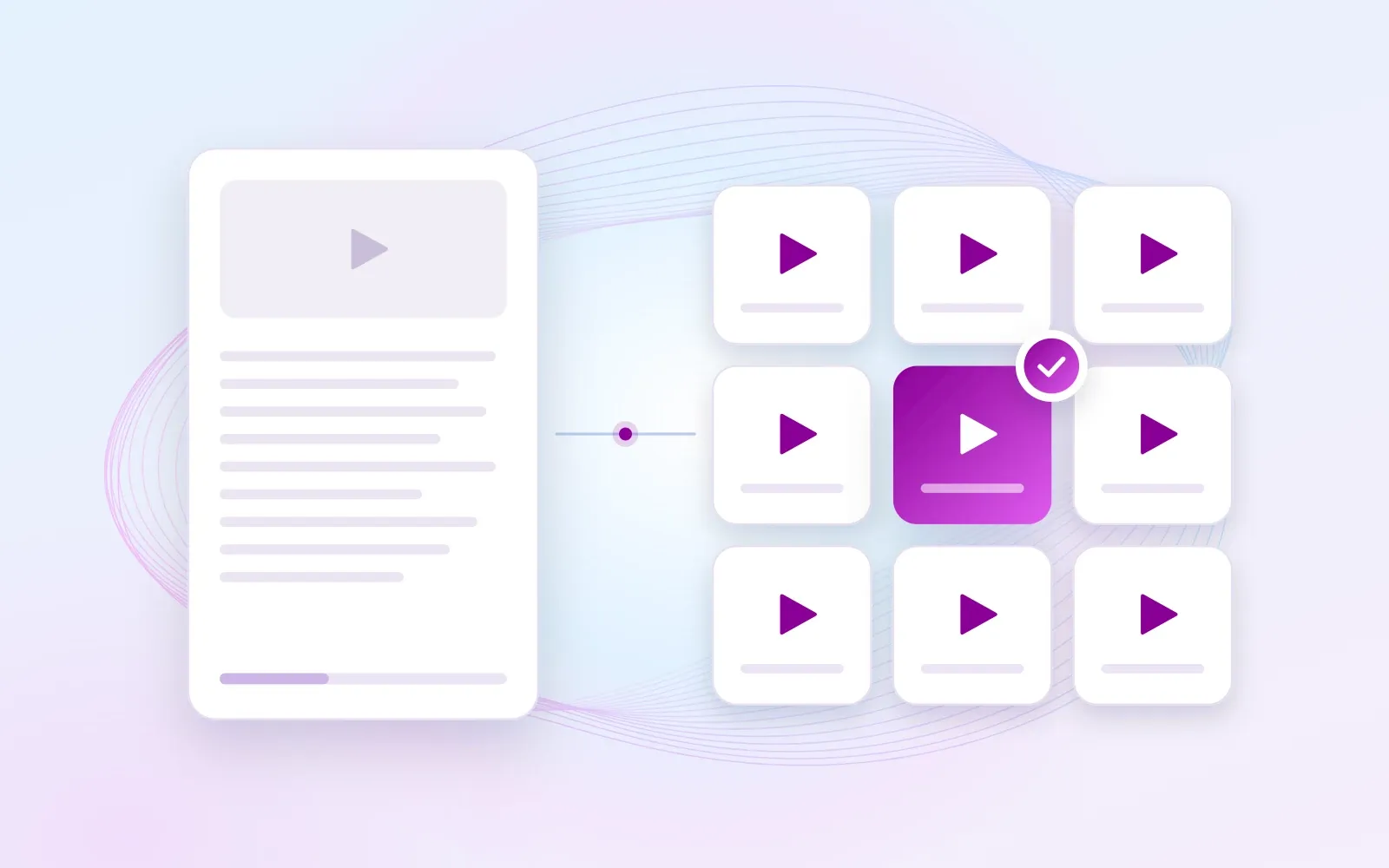
Most training starts with a document. Someone writes a script, builds slides, records. That works as long as the knowledge is already written down. For specialist training it often is not. It sits with the people who have done the job for years, and they have no time to write scripts.
Interview-to-training reverses the order. It starts with a conversation and ends with a course.
What is interview-to-training?
Interview-to-training is a way of creating courses in which a subject matter expert is interviewed instead of writing anything themselves. An AI asks structured questions, follows up where an answer stays vague, and asks about concrete cases rather than the ideal process. The answers become a course draft: chapters, narration script, visuals, quiz questions.
So the expert provides the substance but not the format. They describe what they know and check at the end that the result is right.
The term sits alongside two other routes into a course: document-to-training, which starts from existing material, and text-to-video, which voices and illustrates a finished text. How the three routes fit together is covered in Create learning videos with AI.
The process in four steps
Interview
The expert talks to an AI, by voice or text. The questions focus on concrete situations: what was the last difficult case? How did you notice something was wrong? What would a new colleague have got wrong? A single interview takes around 30 minutes.
Structuring
The conversation is turned into a learning structure: objectives, chapters, examples drawn from the cases described, and knowledge check questions. The language is smoothed for learners without losing the technical detail.
Expert review
The draft goes back to the person who was interviewed and, where needed, to a second expert. They correct errors, fill gaps and approve. This step is not optional: a course nobody has checked for accuracy creates more problems than it solves.
Finished course
The approved course is voiced, with an avatar or screencast if needed, translated, and delivered to the LMS as a SCORM or xAPI package. When something changes later, the course is updated at the source rather than produced again.
How it differs from other approaches
Compared with a classic authoring tool: there, work starts with empty slides and someone has to write the knowledge down first. Interview-to-training removes that step. The expert’s time goes into the conversation and the review, not into layout.
Compared with a plain expert interview: an AI expert interview for knowledge capture records knowledge, for example as a playbook with an owner and a validity date. Interview-to-training goes one step further: the goal from the outset is a course that learners complete and whose completion can be tracked.
Specialist training without an instructional design team
Interview-to-training makes most sense where expertise goes stale or walks out the door faster than an L&D team can produce courses. Typical cases:
- Specialist training in engineering, service or back office that used to be delivered as verbal briefings.
- Processes with many exceptions, where the normal case is documented but the special cases are not.
- Key roles whose knowledge needs to become onboarding material before a move or retirement.
It is less suitable where good, current documentation already exists; document-to-training is quicker there. Specialised tools are also stronger for heavily branched scenarios and simulations. And where a course is mainly about attitude, such as leadership communication, no interview replaces a good trainer.
The underlying need is well known: in a 2018 Panopto and YouGov survey of US employees, respondents estimated that 42 percent of their job knowledge is unique to them. Anyone who wants to turn it into training has to reach that knowledge first. The interview is the most direct way to do that.
A first try
Pick a topic that keeps generating the same questions to the same person. Run one interview, have the draft reviewed and roll the course out to a small group. Then measure whether the questions to that person go down. That number tells you more about the value than any average.