Skip to content
AI & company knowledge

Enterprise Search vs. Corporate Brain: Why Better Finding Doesn't Solve the Knowledge Problem

A good enterprise search finds every document. What is in no document, it cannot find. Why enterprise search and a corporate brain solve different problems.

Sebastian Walker, CEO, Omnora · 4 min read
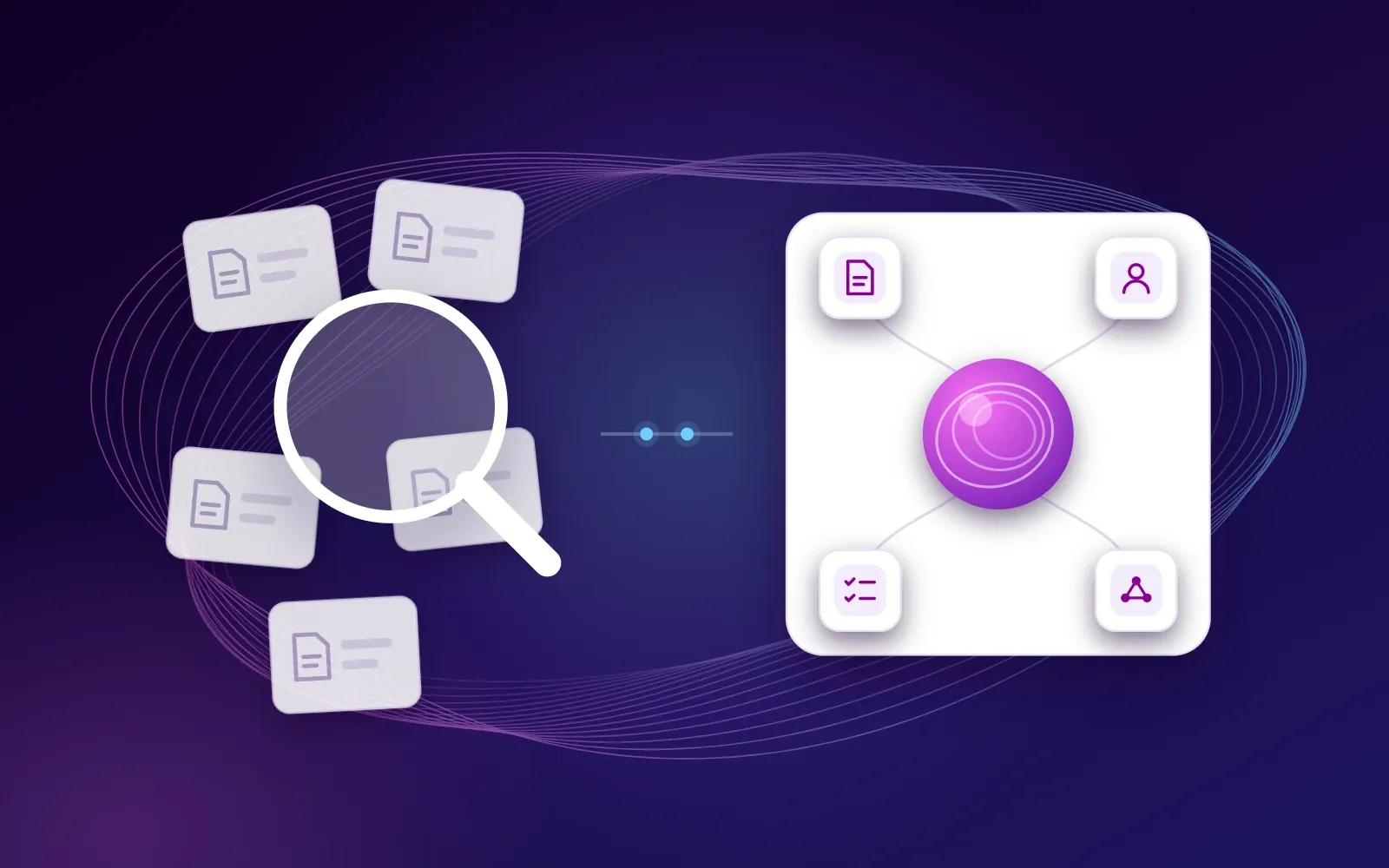
Illustration: on the left a magnifying glass over scattered documents, on the right connected knowledge around a central core
Contents
  1. What search can actually do
  2. The second problem: too many hits
  3. What a corporate brain does differently
  4. Where the two fit together
  5. Frequently asked questions

What is the difference between enterprise search and a corporate brain?

Enterprise search searches existing documents and systems and returns hits. A corporate brain also holds knowledge that was never in any document, such as the decision criteria and exceptions of experienced specialists, and every knowledge item has a named owner and a verification status. Search improves access to what is documented. The corporate brain closes the gap to what exists only in people's heads.

Key takeaways

  1. Search only finds what was written. Expertise that was never documented stays invisible even to the best search.
  2. More hits are not more certainty. Without a verification status nobody knows which of five documents found still applies.
  3. Both have their place. Enterprise search organises what exists; a corporate brain adds what is missing.

The assumption sounds reasonable: our knowledge is there, we just cannot find it. So we need better search, ideally with AI that understands questions and summarises answers. Many organisations invest exactly there, and the frustration with endless searching is justified. According to McKinsey, employees spend around 1.8 hours a day looking for information, roughly a quarter of their working time.

But the assumption behind it does not carry as far as it promises.

What search can actually do

Enterprise search is good at one thing: it makes findable whatever is stored somewhere. Drives, wikis, ticketing systems, email archives, all indexed and searchable through one interface. Modern systems understand everyday questions and merge several hits into one answer. Where documents are good and merely scattered, that is a real gain, and it would be unfair to play it down.

The problem begins at a point no search technology can move. What was never written down cannot be found. According to Panopto and McKinsey, a good two fifths of the knowledge people need for their work is recorded nowhere (42 percent). However good the search, for that share of questions it returns either nothing or something wrong.

The second problem: too many hits

Even where documents exist, finding does not solve everything. A question about the approval limit for supplier invoices easily returns five hits in a mature organisation: a 2019 policy, minutes recording an exception, two emails with conflicting figures, a presentation from a project that was never implemented. The search delivered. Which answer applies, nobody knows.

AI sharpens this rather than resolving it. A language model summarising those five hits produces a fluent answer that sounds plausible and may come from the wrong source. A 2026 Confluence study on AI puts it plainly: the core issue is a context gap, not a gap in AI capability. Why answers without a verified base break down is covered in the article on RAG architecture.

What a corporate brain does differently

A corporate brain starts one step earlier. Its first question is what is missing, not how to find what exists. Expertise is captured actively, in conversations with the specialists who hold it, and reconciled with existing documents. Contradictions are resolved before anyone searches. Every knowledge item gets a named owner, an expiry date and a verification status.

The result is a smaller, reliable base instead of a longer list of hits. People and AI systems work from it alike, whether through an internal chatbot or an in-house AI as described in the comparison with Microsoft Copilot. In Omnora Intelligence Management this is the second step after capture: verified knowledge is transferred to people and systems, for example via an MCP server.

Where the two fit together

Enterprise search does not exclude any of this. It organises what exists; a corporate brain adds what is missing and says which of it applies.

Which leaves the question that should come before any investment in search: for which three questions in your organisation would the best search in the world find nothing today, because the answer exists only in one person’s head?

A corporate brain combines verified expertise with your documents, for people and for AI systems, with a named owner for every knowledge item.More on the corporate brain

Frequently asked questions

What is enterprise search?

Search across several internal systems, such as drives, wikis, email and line-of-business applications. Modern versions understand questions in natural language and summarise hits with AI. But they always work with what has already been stored.

What is a corporate brain?

An organisational memory that combines documented knowledge with captured expertise. Every item has a named owner, an expiry date and a verification status, so that people and AI systems work from the same approved base.

Do we need both?

Often, yes. Where many useful documents sit scattered across systems, search delivers quick value. Where decisive knowledge was never written down, it does not help; that knowledge has to be captured first.

Doesn't AI make enterprise search more reliable?

It makes it more convenient. The answer only becomes more reliable if the sources are right. When AI summarises contradictory or outdated documents, the answer sounds convincing and is still wrong.

Sources

  1. McKinsey: 1.8 hours per day spent searching for information, roughly a quarter of working time [Study]
  2. Panopto, Workplace Knowledge Report / McKinsey: 42 percent of job-related knowledge exists only in individual heads [Study]
  3. Confluence AI study (2026): statement on context as the core problem of AI in organisations [Study]

Capture the knowledge before it leaves.

An AI interview takes about 30 minutes and costs your experts not a single page of writing. Try it yourself or let us show you on your own case.