

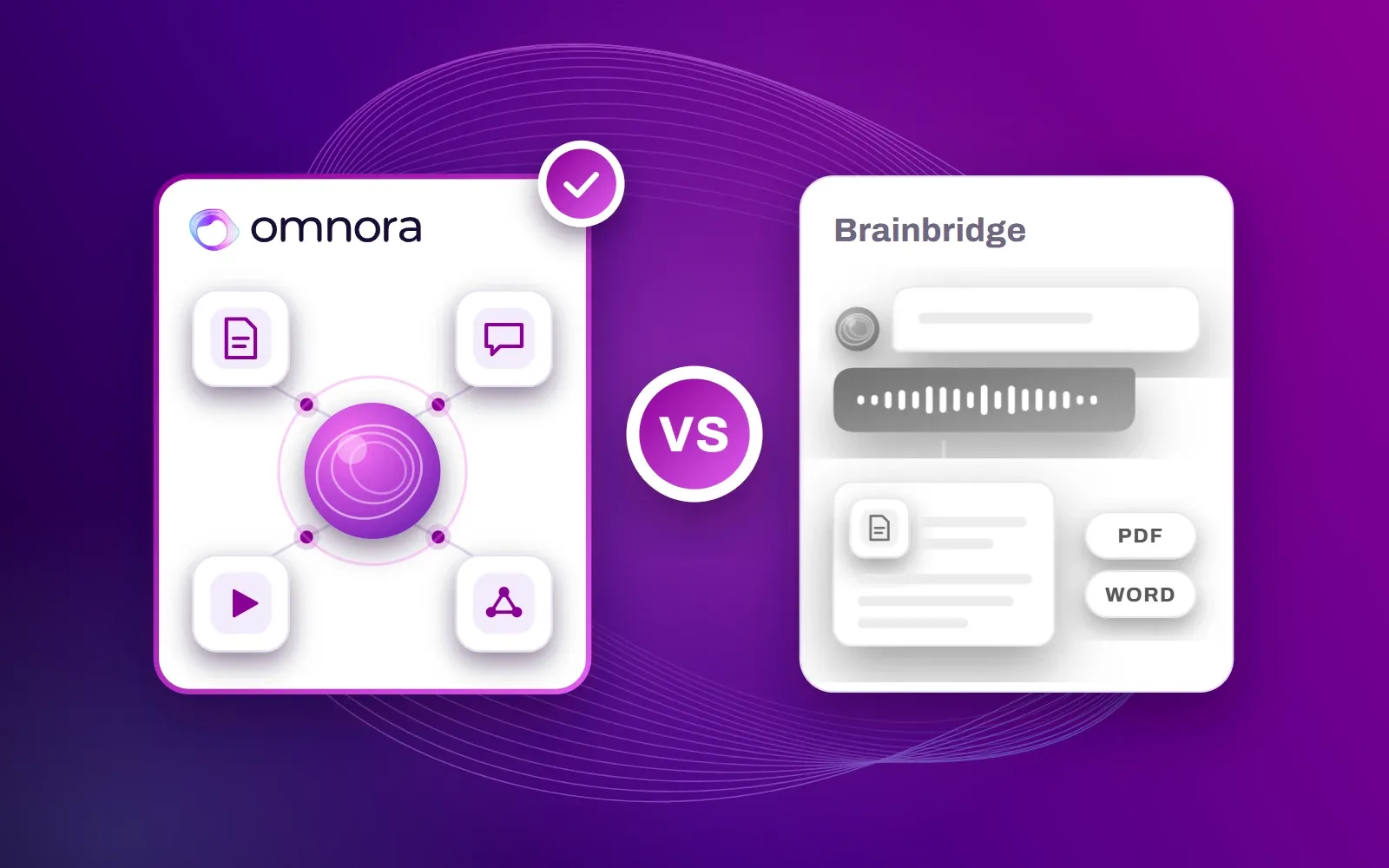
Both capture expertise in an AI interview rather than with a form. Brainbridge treats knowledge management as a continuous cycle: capture, use, review, update. Omnora runs a knowledge initiative with a defined goal: the system schedules AI interviews until the goal is met, and the result becomes documents, chatbots, video training and context for your AI.
- Brainbridge: AI interview by voice or chat, an anonymised knowledge base with chat and topic pages, and an agentic mode that keeps asking when it finds knowledge gaps
- Omnora: A knowledge initiative with a defined goal: the system plans the AI interviews until it is reached, then delivers documents, chatbots, video training and access for AI assistants (MCP).
Two good tools, two different strengths.
Brainbridge keeps a knowledge base up to date and deliberately separates knowledge from the person. Omnora starts from a specific knowledge goal and makes the validated result usable for people and AI.
When is Brainbridge the better choice?
When you want to run the software in your own infrastructure, when knowledge should be stored anonymised, or when employees without a desk should ask and answer by voice message.
- On-premise deployment in the Enterprise package, otherwise a platform on servers in Germany
- Anonymised storage, transcripts cannot be viewed, a template works agreement
- Agentic mode with recurring interview rounds, for example for lessons learned
When is Omnora the better choice?
When specific knowledge has to be captured by a deadline, when it should stay traceable who approved it, and when it should also become video training and context for your AI.
- A knowledge initiative with a goal, interviews planned by the system
- Approval with owner and expiry date
- Video training, AI chat, documents and MCP server from one knowledge pool
Anonymous or with an owner: the basic question.
The biggest difference is not the interview but what is stored afterwards. According to its own security page, Brainbridge stores knowledge anonymised and without a link to the person. That lowers the barrier for employees and makes the conversation with the works council easier.
Omnora takes the other route: validated knowledge has a responsible owner and an expiry date. Anyone who later uses a work instruction or a training built from it can see who approved the content and until when it is valid. Which route fits depends on whether you need broad participation or clear ownership of the content.
Omnora in numbers
- 30 min per AI interview: Around 30 minutes of expert time, in the browser, pause any time
- 5 free AI interviews: on the Free plan, to capture a first person’s knowledge
- 140+ languages: for voice-over and subtitles in video training
More comparisons
- Omnora vs. great2know: Two dialogue-based approaches to capturing knowledge.
- Omnora vs. InfinityMemo: Two AI interviewers for expert knowledge.
- Omnora vs. edubites: AI interviews and a learning platform compared.
- Intelligence Management overview: Capture and transfer knowledge, one verified knowledge pool.